NHS England has an ‘institutional bias’ against primary care because most of its senior leaders come from a secondary care background, a former government advisor has said.
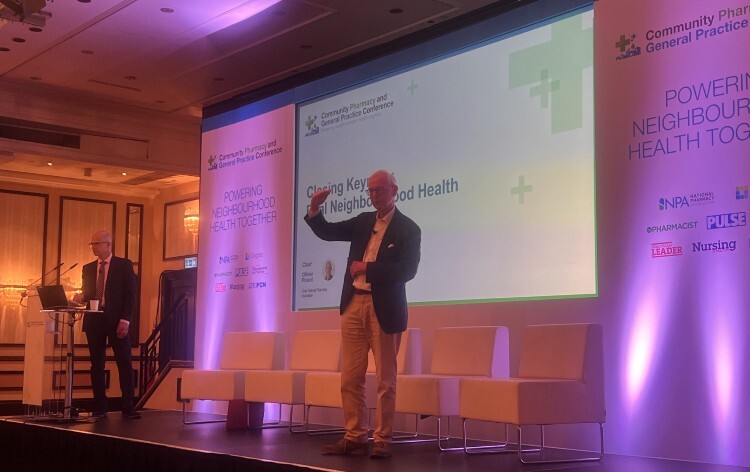
Speaking at the Community Pharmacy and General Practice Conference on 21 June, Sir John Oldham, former strategic advisor to the Department of Health and Social Care (DHSC), told delegates that the structure of NHS England had made it ‘ignorant’ to community care.
He said: ‘You’ll have heard for years that we want to shift care from hospital to community, but it’s never really happened on a big scale. It’s worth thinking: why?
Related Article: NHS success depends on strong pharmacy and GP collaboration, minister says
‘There have been design failures, operational failures, management of change failures and leadership failures – and the leadership failure has to be put at the door of NHS England.
‘They have what I might describe as an institutional ignorance and bias against primary and community care, not through wilful malevolence but through the very nature of the beast itself.’
He explained that, until recently, there was no executive or non-executive on the NHS England board who had direct experience in primary or community care, with most senior leaders coming from hospital management backgrounds.
Professor Sir Sam Everington, a GP in East London and former BMA chair, and clinical lead at Tower Hamlets, joined the board on 1 August, 2025 and Dr Claire Fuller, also a GP, took up the post of medical director in 2023.
He added that real neighbourhood health is about more than the NHS as it will require collaboration across primary care, and a deep understanding of patients’ needs.
Related Article: HPV vaccine reduces risk of cervical cancer death to 'close to zero'
He advised clinicians to ‘rigorously understand the needs of the people you serve, mobilise those collective assets through fostering relationships, and change financial flows to reinforce that collaboration’.
He recognised that primary care clinicians are disadvantaged by the ‘siloed and fragmented’ system they operate in but urged them to work together as a ‘single, powerful voice’.
He said: ‘If there’s a vacuum, occupy it. I really believe this is the last change to secure the future of the NHS care system as we know it.’
Related Article: Boots campaign raises awareness for skin disease of the neck
Delegates at the conference, taking place from 21-22 June at the Birmingham National Conference Centre (NCC), also heard from pharmacist Baba Akomolafe and his GP wife Dr Dupé Akomolafe about the value of working together.
Mr Akomolafe described community pharmacy as a ‘frying pan’ and general practice as a ‘pressure cooker’ – the difference being that community pharmacists can ‘flip’ into private services while GPs are stuck.

Have your say
Please add your comment in the box below. You can include links, but HTML is not permitted. Please note that comments are not moderated before publication and the views expressed are those of the user and do not reflect the views of The Pharmacist. Remember that submission of comments is governed by our Terms and Conditions. You can also read our full guidelines on article comments here – but please be aware that you are legally liable for any libellous or offensive comments that you make. If you have a complaint about a comment or are concerned that a comment breaches our terms and conditions, please use the ‘Report this comment’ function to alert our web team.